Wednesday, November 26, 2014

The Great and Powerful Oz Blog

So, over the last six months I read the fourteen Oz books written by L. Frank Baum. I bought them all for .99 on a whim (a cheap whim) because they've now entered public domain. (Which I assume is why this travesty was brought into existence. Patrick Stewart, for shame.)  

Remember, originally the Emerald City was green because of
those goggles they wore...

As a kid, I read (nearly) all of the Oz books, found at my local library in rather crumbling hardback editions. I watched the movie religiously when it came on at holidays (hello, life before VCRs!) and my Mom would regale me of tales of how scared her sister was of those flying monkeys. I was a member of the Official Oz Fan Club. My Mom and I even visited the inspiration for the Emerald City, Hotel del Coronado in San Diego.


My childhood copy,
 illustrated wonderfully by Michael Hague
Reading all of these books (again) deserved some sort of commemoration, I decided, and thus I bring you the definitive ranking of Baum's Oz books, from worst to best. While I study Children's and Young Adult lit, I'm not an Oz scholar, so this is all just thoughts and highlights/lowlights, not serious scholarly analysis. There are, as I said, fourteen books. I'm trying to keep my comments for each short.

Clearly, The Wonderful Wizard of Oz exists on its own turf. One of the things that I'll remark upon here though is how some of the conventions change between the initial depiction of Baum's Fairy Land and the subsequent books. As mentioned above, Oz has merely forced everyone in the Emerald City to wear green goggles for so long, "most of them think it really is an Emerald City," a convention which changes once Ozma takes over. Additionally, eventually we learn that no one can die in Oz, but clearly our two wicked witches meet ugly ends at Dorothy's hands in this book. Did you know Munchkins (of Munchkin County) aren't little people? Dorothy's first observation of them: "They were not as big as the grown folk she had always been used to; but neither were they very small." And, of course, there's lots of other cool stuff in WWoO that doesn't make it into the movie, so you should all go read this book if nothing else.

So, onto the rankings. I decided on worst to best because I want everyone to hold their breath to find out what the best Oz book is. No scrolling ahead and cheating.

Dorothy and the Wizard in Oz (1908)
The Wizard is at his flim-flammy best in this book. While he later becomes a legit magic user (one of the few in Oz), here he's just playing tricks with nine tiny pigs (which we will come back to later). This book is notable for the first appearance of one of my favorite phrases: meat people. In subsequent books the Scarecrow and Tin Woodman make all kinds of disparaging remarks about the needs of "meat people's" bodies. While there are invisible bears to fight, and some angry vegetable people, the climax of this book is the trial of Eureka, the pink kitten. Eurkea is accused of eating one of the Wizard's tiny pigs and must stand trial. Really, that's the climax.


The Emerald City of Oz (1910)
Baum was well and truly fed up with Oz in this book. He attempts to wrap things up by bringing Aunt Em and Uncle Henry to Oz (would Dorothy have left them behind to lose the farm? Maybe.) While there's a cool double-narrative with the major Oz antagonist, the Gnome King, it can's save the book. Dorothy and Ozma do defeat him in classic trickster non-violent fashion, but overall the "fairy" elements fall flat. The magical lands they wander into are entirely held together by bad puns, something Baum mercilessly mocked in earlier books. Here we have Utensia where the Captain of the Spoons is "getting rusty" and prefers "stirring times." *groan* The book ends with an epilogue telling readers "YOU WILL NEVER HEAR ANYTHING MORE ABOUT OZ BECAUSE WE ARE NOW CUT OFF FOREVER FROM ALL THE REST OF THE WORLD." Clearly, Baum was feeling done, but only until he needed the money a few years later.


The Road to Oz (1909)
Here we meet Button Bright, Polychrome, and the Shaggy Man for the first time. Button Bright is one of our few (human) male reoccurring characters. He isn't a character with much agency, however, as his main talent is getting lost and being lucky. I find the gender politics of Oz to be pretty progressive, as our heroines really only call on other women in times of trouble, there's never a standard "dude to the rescue" plotline. Things to dislike about this book: the Love Magnet (ugh, what a lazy plot device) and a birthday party for Ozma. Why does the lady need so many birthday parties? She doesn't age, and she has unimaginable wealth. Really, it's downright rude to have a party where people bring you presents in her position. I have to admit, the Scoodler's removing their heads and throwing them at the party of adventurers has echoes of one of my least favorite parts of the film Labyrinth.


The Scarecrow of Oz (1915)
This is what the Scarecrow
always looked like for me.
Again, thanks to Michael Hague.
Wikipedia tells me this was Baum's favorite Oz book. Huh. Well, it's in my bottom third. Another of our female heroines shows up here: Trot (and her sidekick Cap'n Bill). Trot and Cap'n Bill are pleasant enough, but the overall plot is just pretty boring. Button Bright is lost and found again, there's some flying around, and then a cruel king/princess/prince/witch plot that works it's way out. One of the most horrifying features of Oz comes to light here, as the aptly named King Krewel traps garden boy/prince Pon's father: "It is impossible to kill anyone in this land, as perhaps you know, but when my father was pressed down into the mud at the bottom of the deep pool and the stones held him so he could never escape, he was of no more use to himself or the world than if he had died." Trapped in the mud, living, for all eternity. The notion of eternal life in Oz is generally more horrifying than pleasant.


Glinda of Oz (1920) This is the final Oz book, published after Baum's death in 1919. This is also one of the two "original fourteen" books that I hadn't read as a child. As far as gender politics go, this one is a win, as Dorothy and Ozma head off to solve a conflict in a remote region of Oz, and call in reinforcements in the form of Glinda when necessary. This book highlights one of the odd features of the "utopian" land of Oz. While Oz is a magic Fairy Land, the only people officially allowed to use magic are Ozma, Glinda, and the Wizard (having been taught magic by Glinda and left the life of a conman far behind). Seriously, though, a magic land where magic is all but outlawed? It seems awfully dictatorial for the beloved girl ruler of Oz to keep all the fun for herself. Best conceit of this book is, by far, the canned brains of the Flatheads (heads too flat for brains, what's a Flathead to do?)

Glinda's Magic Book: recording every event as it happens.
Everywhere. 
The Magic of Oz (1919)
Oh, for heaven's sake. Another birthday party for Ozma. Now everyone needs to go on a quest to find the perfect present. Naturally, the Gnome King is stirring up some trouble, this time trying to get the talking animals to rise up and enslave the population of Oz. There's a magic flower which is pretty cool, the glass cat's pink brains can be seen working, and they tame some tiny monkeys.

You've made it halfway through the books! Read on!

Tik Tok: Original Steampunk

Tik Tok of Oz (1914)
For being one of my favorite characters, Tik Tok's book doesn't make it too high on my list. Really, it's much more focused on the Shaggy Man and the introduction of another human heroine: Betsy Bobbin and her mule Hank. It's saving grace (from the fairly dreadful plot of Queen Ann Soforth trying to conquer Oz) is the tunnel to the other side of the world where the characters (including the Shaggy Man and Polychrome) meet a dragon. Now, that's fun. What isn't fun, again, is the downside of eternal life, seen here: "If the Rak catches us, and chews us up into small pieces, and swallows us--what will happen then?" The response, naturally, in a land where no one ever dies is "Then each small piece will still be alive." See? Horrifying.


Patchwork Girl of Oz (1913)
Radium chocolate? Why not?
This marks the triumphant return of the Oz books after Emerald City of Oz declared the land of Oz as cut off from the world forevermore. Or, for several years, at any rate. Luckily Baum seems to have come back refreshed from a few years off and produced Patchwork Girl. What I like most about this book is the hero, Ojo, and his refusal to allow the Patchwork Girl to be created as a dumb slave. When no one is looking he adds heaps of extra stuff to her brains, making her into a full blown character instead of a stuffed slave. You go, Ojo. The same wizard has brought a glass cat to life and this cat has one of the best catchphrases of all time: "I have the handsomest brains in the world. They're pink, and you can see 'em work." (The random Munchkin wizard is using more illegal magic use that Ozma has to go put a stop to eventually). The thing that got the biggest exclamation from me was the use of radium in this book. We enter another strange corner of Oz to find "All the furniture was made of the same gloriuos metal, and Scraps [Patchwork Girl] asked what it was. 'That's radium,' answered the Chief. 'We Horners spend all our time digging radium from the mines under this mountain and we use it to decorate our homes and make them pretty and cosy. It is a medicine, too, and no one can ever be sick who lives near radium." So there you go then!

Is there nothing radium can't do? Kills lice and favors beverages!

What's that? TWO tin men? 
The Tin Woodman of Oz (1918)
This one makes it in the top third by sheer weirdness. Did you know the Tin Woodman (who is, by the way, an incredibly vain guy) was once engaged to a woman named Nimmie Amee? That he was in love when his axe was enchanted to chop away his body bit by bit? And, you may recall, that the Tin Woodman wanted a heart most of all from the Wizard. What we didn't know, until 1918, was that he was given a kind heart, not a loving heart. Thus, fiancee forgotten he
off to be Emperor of the Winkies. This book finds him on a quest to rediscover his lost love, which might not actually be the kindest thing to do. Vanity, thy name is Woodman. Along the way we find a Yookoohoo (is this a real thing? Baum certainly uses it more than once) named Mrs. Yoop who reminds me a lot of the giant from Lewis' The Silver Chair. We also discover that another man once fell in love with Nimmie Amee and was similarly enchanted to chop off all of his own limbs and became a Tin Soldier. Now, I know what you're thinking. What happened to those still living limbs? After all, each little piece of you is still alive in a country where you can never die. Well, I'm not going to spoil it. But it reminds me quite a bit of that terrifying taxidermist in John Connolly's Book of Lost Things. One more thing. Remember those nine tiny pigs the Wizard used in his flim-flams? Well, turns out "like all other children in the Land of Oz, they will always remain children, and in the case of the tiny piglets that is a good thing, because they would not be nearly so cute and cunning if they were bigger." Seriously, eternal childhood? Can you imagine if you were a parent of a baby when that fairy flew over the land, "blessing" everyone with the gift of no age and no death? To have a three month old forever? Don't worry though, "Everyone in the Emerald city is happy," said the Tin Woodman. "They can't help it."

You're almost there! You're such a trooper if you've read this far!

The Lost Princess of Oz (1917)
This is actually, factually a worthwhile quest book. No silly pursuit of birthday presents, here Ozma, Glinda's Magic Book, the Wizard's black bag, and Cayke the Cookie Cook's golden dishpan have gone missing. In fact, all the magic in Oz has vanished and it's up to Dorothy and company (Button Bright, the Wizard, Patchwork Girl) to save them. Maybe if they started a wizard school instead of just outlawing magic these problems wouldn't keep cropping up. Anyway, notable mention for the merry-go-round hills and the fact that Toto is finally getting some plot elements (lost growl!) and talking for once.

Classic Ozma. 
Ozma of Oz (1907)
Two words: interchangable heads. Those of us lucky (?) enough to have seen the 1985 film Return to Oz (and had it scar our childhoods) will remember the Princess Langwidere (Mombi in the movie) and the hall of women's heads. Return to Oz is a mashup of a few different books, but some of the main elements come from this installment (and really, Oz the Great and Powerful deserves it's own gender-politics blog post). At any rate, this is our first introduction to a few really important characters: Tik Tok, Ozma in her female form (more on that in a minute) and Ruggedero, the Gnome King. The Gnome King is the primary antagonist for the series, and I haven't really spent much time on him. However, yes, he does have a problem with eggs and yes, he does turn people into knicknacks. He also gathers armies multiple times to attack Oz, traps the Shaggy Man's brother, and is greedy in exile. Few books pass without the Gnome King getting up to no good (even, somehow, when the much nicer Kaliko takes over for Ruggedero). There are also lunchpail trees! How badly do I want a lunchpail tree? Pretty badly. Overall, Ozma of Oz wins the Bronze Medal of Oz sequels.


The Gnome King, Ruggedero.

Rinkitink in Oz (1916)
This was definitely a surprise to me, and proof that nostalgia doesn't always carry the day. I hadn't read Rinkitink before and was pleasantly surprised when I found it. Rinkitink has a nice classic fairy tale vibe with three magic pearls, a displaced heir, an enchanted goat, and a quest to regain one's homeland. It was rather nice to find a wholly "other" story here, at least until the Gnome King shows up! Gnome King! *shakes fist* Oh, also, a major instance of casual racism from the books (transformation goat-to-lamb-to-ostrich-to tottenhot--which is a lower form of a man). Hm, maybe I shouldn't have placed it so high in my list? Well, that unfortunate moment aside, I like Rinkitink. Racism tarnished silver medal for you, my friend.

Finally! The one! The only! The best Oz sequel!

The Gump 
The Marvelous Land of Oz (1904)
This is the second Oz book and has some of the most interesting gender politics. The book starts as General Jinjur and her army of girls come and capture the Emerald City from the Scarecrow who has been ruling since Dorothy left. (But wait, you say, where's Ozma? We'll get to that). While the girl army is mocked for being...girly, their knitting needles effectively conquer the city. General Jinjur's rule doesn't last, but when the city is liberated Baum offers us this tidbit: "I'm glad you have decided to come back and restore order, for doing housework and minding the children is wearing out the strength of every man in the Emerald City." When the Scarecrow questions why the women do it so easily the man sighs and says "Perhaps the women are made of castiron." That's right, gents, housework is work. The second interesting thing here is the character of Tip. Tip lives with Mombi, a wicked sorceress (but not yookoohoo, if anyone knows the disctinction). He steals her magic powder and runs off before she can turn him into a statue instead of merely a slave. Along the way he brings to life Pumpkinhead Jack (notorious for worrying about spoilage) and the Sawhorse (the only horse in Oz, as it turns out), and eventually the Gump, pictured above. The Gump is the best, btw. However, at the end of the book we learn that Tip himself has been transformed by Mombi and is...in fact...a girl! Tada! And not any girl either, but the ruler of Oz herself (transformed with the help of the Wizard, back when he was not such a great guy as he becomes later. Continuity-schmontinuity). Tip is anxious about his transformation, but everyone assures him that girls are just as nice and smart as boys. As, indeed, Ozma is. Gold medal for progressive gender politics and sentient furniture that asks to be disassembled.

So, that was a long blog post, and congrats if you hung in until the end. I shan't be reading any of the other canonical Oz books in the near future, I don't think. I may have some thoughts on Oz the Great and Powerful as a follow up, but for now, we've reached


Wednesday, February 12, 2014

On Monuments and Men

It's been too long since I touched this blog. As I told my friends recently, I'm too busy applying for jobs to do my job! This post on THE MONUMENTS MEN (2014) is too good to pass up, however, especially as it can work nicely in conjunction with my post on memorials (monuments, memorials, you see the connection).

I was excited about the release of THE MONUMENTS MEN because I'm a sucker for films about art (and art in general, as you can see in my last post), Matt Damon (BOURNE IDENTITY 4-evah), and Cate Blanchette (no clever aside, she's just fabulous). We watched it over the weekend at, appropriately enough, Midtown Art Cinema. I'm actually not at all a sucker for films about Nazis because they're (obviously) largely war films and that just isn't my genre. This may be a surprise considering how much I write about the Holocaust on this blog, but I really don't spend a lot of my personal entertainment time consuming Holocaust texts. Truth be told, I'll pretty much watch a cartoon over anything else if given the chance. Anyway, despite all of that, this post and my next one should both be about contemporary films that feature Nazis in some way. MM here followed by a post on 2011's THIS MUST BE THE PLACE which I really enjoyed and can't wait to talk about. However! MM is fresher in my mind and harder to rewatch since it's still in the theater so we'll tackle that one first.

For those of you who are unfamiliar with the film, here's a trailer that sums things up pretty well: 


The film was fairly poorly reviewed, with a 34% on Rotten Tomatoes. LA Times critic the film never finds a consistent tone and ends up lacking in all areas" while The New York Times critic Manohla Dargis believes it "slices off a sliver of a great World War II story and turns it into a lightweight entertainment that doesn’t ask you to think too hard." However, I found myself thinking only too hard about what remains largely unsaid in this film about eight men who go to save the great treasures of Europe from the Nazis.

Frank Stokes, played by director George Clooney, has a voice over which states "If you destroy an entire generation of people's culture it's as if they never existed...That's what Hitler wants." Yet the culture that's being destroyed here is curiously nondescript. Hitler, after all, wasn't aiming to destroy European culture in general. While there's an acknowledgement of the importance of the arts to "our" identity, the statement remains a fairly hollow one. 

Stokes' claim in this first preview seems to attempt to engage with one of the central elements of genocide itself: the concept of social death, without actually asking with the difficult questions of whose culture is being destroyed or why that even matters. ("Because it just does" isn't an acceptable answer for me.) Claudia Card's article, which I've linked to above, is a great analysis of culture, genocide, and their relationship to feminism, and I recommend reading it. Her summary of social death is the following:
Social death, central to the evil of genocide (whether the genocide is homicidal or
primarily cultural), distinguishes genocide from other mass murders. Loss of social
vitality is loss of identity and thereby of meaning for one’s existence. Seeing social
death at the center of genocide takes our focus off body counts and loss of individual
talents, directing us instead to mourn losses of relationships that create community
and give meaning to the development of talents.
Genocide is, at its core, an eradication of not only individuals but of identity and culture. Card, like Judith Butler in Precarious Life, asks us to reframe our understanding of genocide so it allows us to mourn not abstract numbers, but instead, reminders of what we all share. Relationships. Community. Culture. Seen in this way genocide or mass murder becomes less about the moment a life is extinguished and more about the process of removing all cultural signifiers from one's life. It is a violence against the symbolic, before the violence against the physical being, and each are equally important when conceptualizing genocide.

So, let's turn back to THE MONUMENTS MEN. Whose social death does Clooney as Frank Stokes seem to fear in this trailer?


He warns us of the "high price that will be paid if the very foundation of modern society is destroyed." What is that price? What comprises the foundation of modern society? The film fails to answer these questions. Just briefly in this trailer you can see one of the film's few references to Jewish victims: around 1:30 Cate Blanchette answers Matt Damon's question: "What is this?" with "People's lives." Surrounded by furniture, packed crates, and nicely arranged tea sets we see the tidy way that social vitality can be removed, inventoried, and stored away. This process mirrors the physical violence that is being enacted elsewhere: removal of bodies to camps, records of arrivals and deaths, and mass graves or crematoria. Yet this scene in the film is hardly longer than the one we see in the trailer itself. The movie rushes on without allowing us a moment to reflect and ask ourselves: wait, whose culture are we saving?

Now, MONUMENTS MEN never purports to be a story of Jewish culture, and perhaps I'm being too hard on it. Yet all we seem to come away with a sort of sense of smugness. Modern society hasn't been destroyed, after all! While greedy Hitler wants it all, and will destroy everything like a 2-year old if he can't have it, he really only wants certain parts of modern society. The non-Jewish parts. As does the film itself. There's a brief reference to the number of Torahs found and saved at the end of the film, and Clooney puts the smack down on a typically cold-as-ice Nazi in the film's closing moments. Mostly, however, this film is a celebration of some indomitable spirit of western culture--a sanitized, dehistoricized version of what Card would call social vitality. This leads me to my second criticism of MONUMENTS MEN. It fails to engage us on the subject of why art matters in the first place.


Anyone who has spent an afternoon wandering an art museum (particularly the modern art area with the Picassos and their demise that we're supposed to feel so troubled about in the film) is familiar with the following statements: "That's art?" "I could have made that" and the dreaded "I don't get it." For MONUMENTS MEN art is "the exact reason why we're fighting. For a culture, for a way of life." Yet the film never answers the crucial question of why art matters. It matters....because it matters! Now lets watch beautiful people run around for a bit. 


Is it so unreasonable to ask one art (film) to support and explain a bit why another art (painting/sculpture/architecture) matters? What do "we" (that troublesome, nebulous word in this film) risk if "we" lose our artistic heritage? I wanted this movie to sell me more on why art matters, to inspire me to see fine art as a viable part of my contemporary cultural identity. I wanted it to ask me to think how art makes an us out of a group of disparate individuals.

At the film's close, an older version of Frank Stokes looks at one particularly important statue from the movie with what we're to assume is his grandson. There's some awesome 70s hair, and an indication of Stokes' satisfaction with a job well done. It is another moment that fails to ask viewers to consider how or why art itself is worth saving as Stokes leads his grandson away suggesting ice cream. The final moment underscoring those ideas of social vitality (vs. the social death that characterizes genocide) is asking us to think about the power of ice cream to bring a family together, not art. I love ice cream, don't get me wrong. It's a foundational part of my childhood, in fact. However, it doesn't answer the question: why save this art? How does saving it, perhaps, save modern society itself? Do we get it, now? Maybe we should have just rescued the ice cream trucks and called it a day. Another artist happens to agree with me:

"Nazi lite." An inelegant way of dealing with such a complex story, one that should acknowledge the problems inherent in the very mission of the film itself: to save what "we" value, not the already tattered and torn European Jewish culture.

Cate Blanchette, by the way, is the best thing about this movie. Check out our "lone heroine" which isn't a problematic marketing tactic at all.


If you want more information on this topic you can look towards Lynn Nicholas' The Rape of Europa and the PBS documentary of the same name.  Also of interest, particularly in its examination of Herman Goering, is Edward Dolnick's The Forger's Spell, a book about how Europe (and the Nazis) were taken in by Vermeer forgeries.

Tuesday, July 16, 2013

A Year of Memorials

Now I'm back to the Holocaust for a couple of posts, but we won't leave popular culture out entirely. This post primarily deals with the real world, and the next one will be about popular culture and the last attempts to capture Nazi war criminals before they are all (dead and) gone. For some background, I pretty much spent the entirety of 2009-2011 reading, writing, and learning about the Holocaust. I took classes, I read books upon books, and a wrote a manuscript on young adult Holocaust literature. You can see some pieces of the last chapter of that book represented here on this blog, and more in The Journal of Hate Studies and (most likely) soon in Children's Literature in Education. (You can read both of these journals online--who doesn't love open access?  Go forth and read someone's article!  It's free and will make you smarter!) It's been an incredibly satisfying project to work on, in part because I believe there is something important at stake when thinking through how young readers are introduced to the concepts of identity, hate, and genocide.


Prison--Terezin, Czech Republic
Beyond the literature, however, how are young adults (among others) asked to interact with the Holocaust?  There are movies, of course, and it seems like SCHINDLER'S LIST (1993) comes up at every turn. Really though, memorials are one main site of interaction between people and genocide. I've been to three Holocaust Memorials/Museums--United States Holocaust Memorial Museum (USHMM), Terezin Memorial in the Czech Republic, and New England Holocaust Memorial (NEHM) in Boston--within the last year and want to take some time to reflect on the different experiences of each, as I'm still trying to unpack what they meant to me. (I've also been to the Anne Frank House in Amsterdam, but that was a decade ago and therefore not as fresh in my mind.)


I've written a bit about my experience at the USHMM here, and it's something that I'm still working through. As I told my husband, I think if I lived in D.C. I'd be there ALL the time trying to work out how I feel about it. (I'd also spend a lot more time in the exhibit for children and young adults: titled Remember the Children: Daniel's Story which has an accompanying book by YA author Carol Matas.) It's a moving experience to be in the museum. I was overwhelmed from the start--which is the goal of the place. It's dimly lit, the corridors are narrow and crowded, there's an overwhelming amount of information, and it includes concentration camp artifacts that aggressively remind visitors of the reality of the history. These artifacts have weight--they weigh you down with their corporeality and in some cases their sheer numbers (the shoes, the scissors, etc.) They are important evidence of the camps and lives lost as well as emotional touchstones, scattered throughout the corridors and image/text of the body of the museum.


USHMM Interior- Main Room (Wikipedia Image)
They, no doubt, make a successful emotional experience. Even the building's architecture contributes to this with the use of light and shadow and spaces for reflection that offer visitors alternating moments of peace and horror. The open, bright space to the right is the main entrance to the museum. It contrasts with the much darker exhibit areas, which are punctuated by light filled bridges (still containing terrible information) and areas of reflection that are full of abstract art (see example below) and benches. These rooms also contain guards, who will make sure that you're doing okay. What a job that must be.


Sol LeWitt's Consequence (USHMM Image)
One of the most unexpected aspects of the museum, for me, was the way it uses artwork by abstract artists. Pieces like LeWitt's, on the left, highlight the power of non-representational art. How often have I been in an art museum and heard the following: "I don't get it." or "I could make that." or "This is art?" Yet after the crush of images, the overwhelming amount of suffering the museum presents visually, non-representational art comes as a relief. LeWitt's Consequence sets up another series of images that could be read as confinement, and certainly along with the title isn't designed to be a "happy" piece.  (The USHMM page describes it as "The rhythmic pattern of squares within squares invites introspection, while the fields of color suggest absence of lives, families, and communities made vacant as a consequence of the Holocaust.") For me it is one that offers relief  while refusing to deny the emotional experience of going through the museum itself. As I said, every aspect of the place is carefully designed to make the most of the emotional journey they are taking you on. (See my blog below on the room of shoes and the train car, as I don't want to be too repetitive here.)   


So how does this huge, detailed museum contrast against other Holocaust memorials? When I went to the Czech Republic and Germany this summer I knew I wanted to visit some Holocaust sites, but at the same time my purpose behind the trip was not "Holocaust Tourism." After doing research and looking at some recent children's/YA lit on the subject I decided on Terezin as the place I wanted to spend a full day exploring, in part due to the critical acclaim Ruth Thomson's book has recently received. (You can see more pictures of the place on my Flickr page.)

Outside Small Fortress--Terezin, Czech Republic

We took a bus from Prague to Terezin (Theresienstadt in German), one which runs every hour or so, primarily shuttling tourists out to the town. We also accidentally got off the bus at the "wrong" stop--most people go to the main museum first and the Small Fortress second, but I'm glad we ended up doing the opposite. Above you can see the approach to the Small Fortress (SF) from the bus stop: rows of graves for those who died here, both named and unnamed. The SF was primarily used as a prison for political prisoners, Jewish resistance members, and others who actively fought the Nazi regime in the Czech Republic. The town of Terezin itself was used as a holding area/camp and propaganda site (more below).


Small Fortress Walls & Moat--Terezin, Czech Republic
Terezin is an unusual camp because it existed as both a fortress and city long before the Nazi takeover of the Czech people. Terezin was an actively functioning city at the time of the Nazi occupation of the Czech Republic, and the city's residents were removed to make way for a crush of Jewish prisoners, held at Terezin until they died of disease/starvation or were deported to death camps. The SF was, in fact, a fortress designed to be used in various smaller conflicts with Germany from the 1700s onward. It was an engineering marvel, although it never really saw much combat action. Still, this made it the perfect location for a Nazi prison, as it was already fortified and enclosed. You can see the two sets of walls and former moat between them to the left. We were there on a lovely day, which of course makes things seem somewhat surreal (as the town of Terezin itself does.)


We happened to get there at the same time a tour in English was beginning, so we tagged along. What I found most interesting about the tour was our guide's insistence that we consider multiple atrocities that went along with the SF.  Of course, the deaths of Jews and political prisoners are memorialized here, some in more representational artwork like the pieces pictured below. These pieces perform a significantly different purpose than those at the USHMM, to evoke the horrors of the deaths rather than offer respite. When our guide led us through the prison itself (see first picture above) he was sure to point out the crowded conditions that literally led to prisoners suffocating--there just wasn't enough air for all the men they crammed in crowded rooms. However, after the war, these same rooms were used to hold German prisoners, in similar conditions to the Czech prisoners of a few months before. Many died from disease and unsanitary conditions and inhumane treatment, just like while the Nazis controlled the space. It was particularly interesting to hear this interrogation of war atrocities from a Czech guide, one who clearly also revered the political prisoners (and Jewish victims) who fought the Nazis and were held at the SF. It serves as a reminder that simply creating a monolithic category of Nazi "monster" to be universally reviled based on their identity alone is not a terribly progressive response to the Holocaust. This is also one of the fundamental challenges of genocide in general--the ability to say "I will treat you in a human(e) way, even as I acknowledge the acts you committed." This, of course, morphs into an important question in Holocaust representation: can we have understanding that doesn't also mean forgiveness? Humane treatment has the potential to feel like weakness or forgiveness, even when it doesn't have to be. 

Sculptures: Stele for Terezin by Celiberti, Shadows of the Executed Prisoners by Hladik , & nameless by Chochole 
The SF Museum and Memorial in Terezin (as well as the town of Terezin, below) were terribly different experiences for me than the USHMM. Part of it, I think, is the free form exploration that the SF encourages. You can walk around the fortress as you desire, finding various pockets of information, artwork, and tours.  This makes it much less a curated emotional journey and more of an exercise in personal curiosity. This is made even more clear when you get to the town of Terezin itself. Terezin was a unique place within the Nazi camp structure--the site of a preexisting town that was taken over and used in propaganda videos for the Red Cross, such as this surviving fragment featuring happy "residents" playing soccer. There's a museum devoted to the victims of Terezin, where a theater shows a short program on the propaganda film, a room full of the names of the children who died at the camp, and a crematoria (which I didn't visit. I have my limits.)  For young visitors, this museum is probably the most informative and emotionally impacting element of the area. It highlights child victims in a way that was clearly compelling for the young adults in the museum, and the short movie (played in a dozen languages throughout the day) gives some background in a brief and interesting way. Yet, beyond that museum, the town that was is a town again, a place where people live, and eat, and shop, and play.

Panorama of the town of Terezin today.

All of these things were happening in town as we waited for the bus to take us back to Prague. It's a place that feels haunted, yet lived in. All the buildings have plaques noting what role they played in the camp, and what they do today. Quite a few are abandoned, such as the church seen here. It's an uncanny version of both a town and a camp, neither/nor and struggling to find its place and move on. It's the fact that it still exists as a town that makes for such a different experience than one finds at more curated Holocaust Memorials.  The museum was well organized, but outside the museum walls there was just so much THERE there (Gertrude Stein shout-out). No one ever lives a life within the walls of the Holocaust Memorial Museum, but people will live out their lives in the sight of the Small Fortress and the crematoria in Terezin, in architecture that is forced to re-present itself as housing and not prison once again.


"New England Holocaust Memorial" by Greenberg on Flickr.com

Like Terezin in one small way, the New England Holocaust Memorial in Boston is a lived space. It's just down the street from the exuberance of Faneuil Hall's street performers and souvenir shops, and sandwiched between Boston City Hall and the Union Oyster House. It occupies a skinny space jam-packed with tourists and city workers. As you can see on the left, it's in a park-like space and while narrow is also tall enough to be noticed among Boston's short skyline. Like the USHMM it asks you to take a particular emotional journey rather than the explorative sense I had in Terezin.  Entering the memorial there are plaques on either side giving some basic information about the Holocaust, one of them reproduces the famous Niemoller quote (one that's been so recently misused and abused).  Each of the towers represents a death camp, and from base to skyline they are full of six million numbers that comprise the dead from the Nazi Regime. What one does at this memorial is walk through the glass columns and experience the architecture, rather than absorb information or explore historical/present spaces. First, there's the name of the camp reperesented by this particular column: Majdanek, Sobibor, Auschwitz-Birkenau, Chelmno, and Belzec. Second, there are steam grates (see below) that both make noise of steam escaping and shine small points of light, evoking stars even when viewed in the daylight.  The walls list some of the six million numbers, offer quotes from survivors, and reflect our own images back at us (also evoking Maya Lin's Vietnam Memorial).


"Steam Grate w/ Stars" by slworking, "Glassy Sky" by Aldwin, and "Shoah" by Bixby all images courtesy of Flickr.com
Like the USHMM, the experience of walking through the columns is designed to provoke an emotional reaction. The noise from the steam grates, for me, was disturbing as one can't help but think of the sound that the gas chambers made at a camp like Auschwitz. The stars clearly reference the yellow patches worn by Jews as they existed in Nazi occupied Europe and the camps. The numbers create an overwhelming sense of loss (although in a troublingly anonymous way). These details, however, don't mean a lot without some context. Unlike the USHMM or Terezin, the memorial in Boston functions in a very limited way for education. Young viewers would need a tour or reading/lesson before attending to understand some of the details the architecture is attempting to evoke.


"New England Holocaust Memorial" by Boyer courtesy of Flickr.com
Finally, the quotes add a certain humanity to the list of nameless victims (it's also really hard to find a list of them online. Guess you'll just have to go yourself). I found this particular memorial to be unexpectedly affecting. I left the sixth tower crying, something that I hadn't anticipated on my meander through Boston on a June day. Again, I feel as though the curated experience is one that prompts this emotional reaction. The architects have thought about how they can best reach us through multiple senses and create an overwhelming experience. I acknowledge the power of this approach, and I understand why it's a compelling choice of those who organize Holocaust memorials (I'd love to go to the memorial in Berlin to see how the experience compares.)  Yet I appreciate the chance to explore that the Terezin memorial and museum offered. While I didn't leave there crying, unlike the USHMM and the NEHM, I left with a sense of reality that's different than what the other memorials can offer.  It's a lived space, and one that most cope with living beyond Nazi occupation, a challenge that's still being worked out by residents and visitors.     

*All photos without attribution (merely title, etc.) are my own and are CC licensed. 

Friday, May 24, 2013

What Puts the Wreck in a Cake Wreck?

Let's take a break from the Holocaust and neo-Nazis for a bit to discuss some good ol' popular culture.  I, like many internet procrastinators, find a set of reliably funny sites to laugh at when I need a break from reading/writing/graaaaaading/etc.  Some favorites are Overheard in New York (or Overheard Everywhere, which I'm secretly dying to be featured on due to one of my more fanciful classroom claims), videos of Maru on YouTube, and Cake Wrecks.


Psychedelic, no?
Cake Wrecks is a blog devoted to "when professional cakes go horribly, hilariously wrong."  This has probably happened to many of us, including this winner that my Mom got one year. Reportedly it was not only fancifully decorated with these "flowers," but it tasted odd enough that my grandfather decided it was really better to push around on his plate than actually eat.

Cake Wrecks strives to only mock those cakes made by professionals, never to make fun of our friends' good-natured cakes.  Although, occasionally one can end up with a really talented baker friend and get surprised by a cake like this one, from my 29th birthday.

So cute! Thanks, Kelly!

Anyway, Cake Wrecks is also written by a blogger with a great sense of humor and ability to make puns out of just about anything.  The site has been successful enough that there are two spin-off books for purchase, and author Jen Yates goes on book tours around the United States.  It's a phenomenon, is what I'm saying, ok?  So why write a blog about it?  Clearly I'm not "just" adding this here to praise some funny sites and add cake pictures from my past.  (All cake images beyond these first two are copyright Cake Wrecks).

Cake Wrecks primarily functions on two types of humor: terrible cake "artwork" and terrible cake text.  The things that professionals put on cakes!  There are the infamous "Naked Mohawk-Baby Carrot Jockeys" (which, honestly look like babies riding carrots at least!) to the amazing recently-spotted diploma cupcake-cake (Jen's caption: I call it, "Tar Donkey Butt-Peeing").  The terrible artwork is consistently amusing.  While I won't link to them all, there are terrifying bridal shower cakes with babies bursting from wombs, foot fungus cakes, and unintentionally phallic cakes galore.  

However, it's the terrible cake text that calls for some analysis.  Let's take a look at "The Cake that Started it All:"    


While this (and others below) is a horrible/hilarious mistake it also seems to be an example of what we could deem functional illiteracy.  Functional illiteracy is often defined as "a person whose reading or writing skills are inadequate to everyday needs."  Clearly, this decorator can write.  And read.  But they lack the ability to contextualize instructions, to think critically about what the words mean in relation to each other.  


Literacy rates in America are overall quite high (The CIA, as of 2003, lists Americans as 99% literate).  Yet 2003 studies on literacy have more layers than merely overall ability to read and write to complete simple tasks.  The most recent National Assessment of Adult Literacy was completed in 2003.  Their findings cover prose, document, and quantitative literacy.  Basically, can one comprehend articles, brochures, etc; can one read things like job applications, maps, or bus schedules; and can one understand how to calculate a tip, balance a checkbook, or do basic everyday calculations.  All of these are necessary for basic, everyday life in the 21st century.  (Of course, for tips and checkbooks and buses, there's probably an app for that.  But we'll touch on that later.)  


The 2003 study found no significant change in prose and document literacy between 1992 and 2003.  And quantitative literacy actually went up in that time period:

* indicates statistically significant difference
This would look like a good sign, yes?  However, the study also found that there were "Fewer adults with Proficient prose and document literacy in 2003 than in 1992."  So while we have a good deal of basic literacy in terms of documents and prose, between 1992 and 2003 the overall sophistication of those skills went down.  We can assume, from the fact that these cakes are professionally done, that the decorators were able to navigate a basic job application.  Yet the ability to proficiently interpret instructions gets lost somewhere along the way.  (One might say "maybe they were just high" but I think that distinction goes to the "Happy Falker Satherhood" cake.)  Naturally, I'd like to believe that a robust humanities education would help the proficiency of prose literacy.  But that's going to have to be another post, because otherwise this blog will only ever get hashtagged #longreads and no one will ever read it.

Why does this matter for a blog that discusses power and privilege in popular entertainment?  When you look at the demographics of the 2003 study one finds a clear connection back to various identity categories, including race and ethnicity.  While the rates for African Americans improved between 1992 and 2003 there was a shocking decline in the literacy rates of Latino/as, "down 18 points in prose and 14 points in document."  I can think of a series of potential explanations for this based on dates and cultural trends, including a complex relationship detailed here about NAFTA, outsourcing, and Latino immigrants there's a clear inequality in how literate Whites are vs African Americans and Latinos in the 2003 study (clearly, I'd love to see an updated 2013 study done).  

Seen this one around your social media?
While we may want to believe that we're merely judging others based on their ability to follow "proper" (read: white) sentence structure, what we're actually doing is boiling down complex educational inequalities and laughing at those less fortunate or literate than ourselves (as my poet-friend and editor rightly pointed out recently in response to this user card above).  This makes these cakes seem more sad than funny, a sign not of inattentive workers, but rather those doing their best to make do with an uneven grasp on the complexities of the written/spoken word.


 How does the digital age impact these statistics, then?  As mentioned above, there's certainly an app for calculating tips and balancing checkbooks.  But those, too, are the realm of anyone privileged to carry a smart phone or tablet.  If there is/was an updated version of this study it would most likely raise questions about how online communication impacts the ability to be proficient (can perform complex and challenging literary activities) prose readers.  (We're also lacking any question of visual literacy here!)  Articles such as this one from the New York Times open a discussion on the debate of failing literacy vs. different type of literacy.  This is a topic that I'm looking to explore at SAMLA 2013 here in Atlanta or MLA 2014 in Chicago, although an extended post on the topic will have to wait as this one is already getting pretty longwinded.  Suffice it to say, I'm not going to assume our functional literacy abilities are going down the tubes due to the internet.  And we'll talk more about it later.

In the meantime, don't worry, there's always cakes like this one that need our laughter:

Aww.  It's...cute?

Finally, go now and read the post which this last cake came from.  It highlights the best Cake Wrecks has to offer.

Hate Studies and the Holocaust Memorial Museum

What is hate, and how do we combat it?  Recently, I attended a symposium organized by Gonzaga University's Institute for Hate Studies and American University's Washington College of Law.  The symposium was on "Hate and Political Discourse" and was organized by John Shuford and Robert Tsai in honor of the Journal of Hate Studies 10th Anniversary issue that is forthcoming this October.  Additionally, I visited the United States Holocaust Memorial Museum for the first time and want to use this blog to reflect on those experiences and offer some suggestions for the importance of the humanities in combating hate.
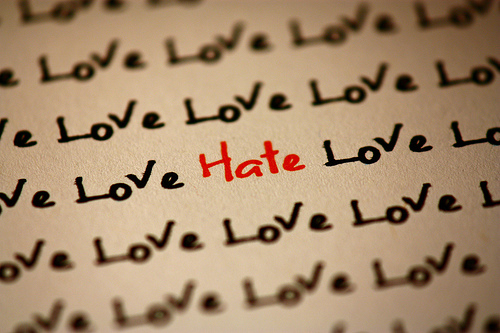
"Love and Hate"
CC image courtesy of Skley on flickr
The Hate Studies Symposium was a fairly intimate event.  The group of scholars chosen for the event was an interdisciplinary one, although it was weighted towards work on the law and legal issues related to hate, including the keynote speaker Professor Mari Matsuda.  The questions we set out to consider were "what do we mean by hate in political discourse?" the definitional problem or challenge and "where does hate come from/how is it sustained?" which leads us to ask "what are the solutions?"

Matsuda's keynote "Is Peacemaking Un-American? On Violence and Ideology" directly addresses some of the concerns that I try to evaluate in my book manuscript and my teaching.  She argued that to say "there's no such thing as a false idea" is problematic for a variety of reasons.  The notion that all ideas are equally true, based on locating them in the realm of opinion is something commonly seen in American culture, including things as forgettable as this commercial for Elmer's Glue:


"But that's just my depinion" the little girl says, and the assumption is that this is something cute, it's adorable how she uses that adult phrase to refer to glue.  But this is a larger claim than just a preference for adhesives, and one that continually causes problems to those who attempt to combat hate speech.  If every opinion is equally true, then no opinions can be challenged.  It follows from that how no opinions can then be changed.  This is what Kwame Anthony Appiah refers to when he criticizes relativism in his book Cosmopolitanism: Ethics in a World of Strangers.  The notion of relativism deployed by "that's just my opinion" shuts down discourse, limits interaction, and sustains false ideas.  Matsuda also reminded participants of one of the fundamental arguments behind  my research and my spring "Cosmopolitan Imagination" course: literature can humanize the "over there."  I look forward to exploring this for a second time with texts like In the Time of the Butterflies, Persepolis, and Interpreter of Maladies.
Other presenters from Faculty Workshop I asked us to consider Willa Michner's "The Psychology of Group Hate"--how groups are associated with the negative that any group member has done, such as responses to American Japanese post-Pearl Harbor and perceived Muslims post-9/11.  This creates what Michner refers to as "algorithms of fear" on a psychological level.  Examples of this type of group hate were covered in Marla Stone's talk on Italian Fascism and propaganda, how propaganda was used in pre-WWII Italy to associate all Soviets with a clearly racially defined "other" that functioned as a threat to the Italian state.  Finally there was Damon Berry's discussion of abjection and blood libel- a compelling paper for my theory-loving heart.  Berry argued that abjection is one important way to understand the pervasive history of the concept of blood libel--the dislike of the crossing of boundaries and the narrative of contamination that is prevalent in blood libel stories from ancient Rome, medieval Poland, and contemporary Palestine and England.
In Faculty Workshop II there were presentations on constitutional histories of lynching from Daniel Kato, legal definitions of hate crimes from Jennifer Scheweppe, and my talk on neo-Nazis in young adult (YA) literature.  While these three topics might seem quite disparate, Dr. Robert Tsai (conference organizer) pointed out how the common thread was in considering competence and hate crimes.  What does this competence require on behalf of citizens?  Who is competent to challenge hate crimes?  I would argue that this question of competence could go by another name: empowerment.  How can we empower individuals to make good decisions when encountering hate?  What sort of empowerment might it take to encourage the idea that we can be wrong, and that's okay?  My argument is that literature is one place where we can do this.  Humanizing the "over there" is one possible avenue for the humanities and combating hate.  Literature can, however, also point us to ways to discuss what Appiah calls "values not worth living by."


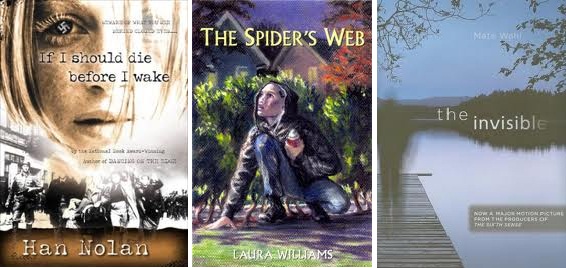
Books from my talk on neo-Nazis and YA Lit:
If I Should Die Before I Wake, The Spider's Web, and The Invisible.
My argument is that young adult literature that features neo-Nazi characters can help readers look at how some ideas are false, some values not worth living by, in how they ask readers to consider the misery and violence that the neo-Nazis inflict on themselves and their communities.  However, in these books its essential that responses come from two places: individual realization on the part of characters and community responses when faced with hate speech.  One of the challenges that I see for humanities work on hate studies is in how we can ask readers to critically evaluate that "over there" through literature and come away with an empowerment to discuss, to engage, and to promote change.  This constantly butts up against the desire of people to respond to the "over there" by embracing their own privilege, rather than interrogating their position within power structures that ask us to accept "well that's just my opinion" as acceptable public discourse.
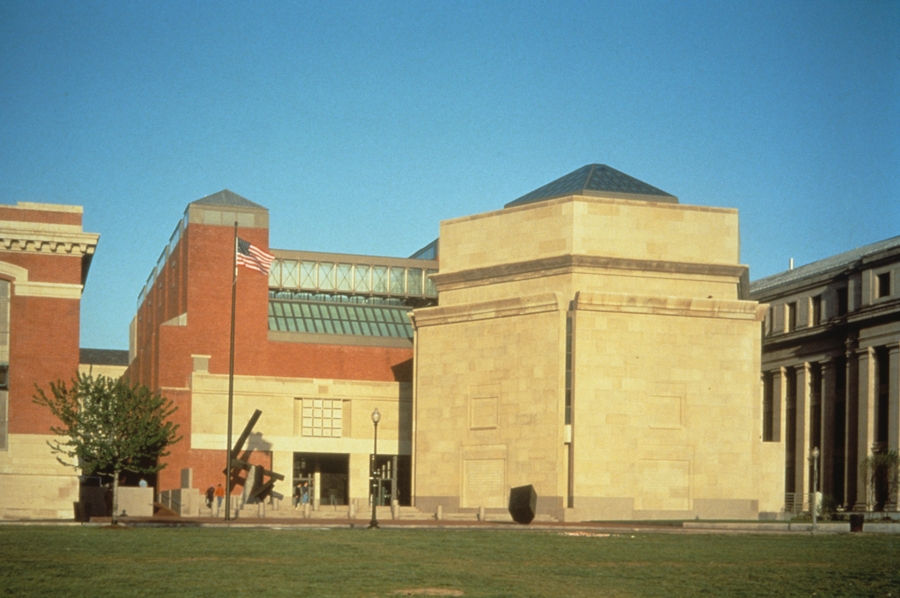
Exterior view of the US Holocaust Memorial Museum.  Image courtesy of USHMM.


This question of privilege is one that the United States Holocaust Memorial Museum skirts, but does not directly address, yet I don't actually know if this particular Museum should be dedicated to interrogating privilege.  (Hello, Museum of Slavery, where are you?)  This is a conversation that I'm still considering, so please leave comments!  Certainly, it asks us to think through why ideas can be false, why values can be wrong, and the extreme example of what happens when false ideas become institutionalized facts about a minority group.  Then it asks us to transform that knowledge into testimony, to become witnesses when we were once spectators.  I've spent, at this point, years of my life studying the Holocaust and its representations.  With all of that knowledge I was surprised at how much the Museum affected me.  I don't know what I expected from the experience, and I'm still having a hard time articulating how my expectations and the reality aligned.  I was overwhelmed and drained, there's not doubt about that.
I've considered the performative aspects of the Museum before and so was aware of some of the logic behind the space and exhibit planning.  In Vivian Pataka's book on theater and the Holocaust she has a excellent chapter ("Spectacular Suffering") covering the USHMM, which I recommend for anyone doing critical work on the Holocaust and memory.  As a small sample:
The use of artifacts and dense documentation to produce knowledge and historical presence, and to shape memory, also convey the incommeasurability of the loss by making this density manageable for the viewer.  What is critical about the D.C. museum, then, is in its use of small bits of everything--shoes, documents, photographs, artifacts--is the sheer, unbearable magnitude of detail (127).
Yet even knowing that, stepping into the elevator holding my ID card (I was a Polish Catholic resistor who survived--several elements that echo my family history accurately) and emerging into the scenes of the liberation of the camps immediately struck me as much more emotionally impacting than I had anticipated.  The Museum is dim, laid out to promote reflection, and an example of how architecture can really enhance the experience of the content.  It is both a Memorial and a Museum, and not just because it contains the eternal flame and hall of witness.  The way the designers used light and space, in addition to content and artwork, was a reminder of how important architecture is.  The use of light in the rooms full of pictures from Eisiskes, the path that encourages you to walk through one of the train cars, and the smell of the room of shoes are all the non-verbal performative elements that make it an often-times overwhelming experience.

The room of shoes, the interior of a deportation train, the images of Eisiskes.
All images courtesy of the USHMM.
I recoiled at the smell of those shoes.  I didn't want to walk through that train car.  I cried (a LOT) when looking at the living faces of the residents of Eisiskes.

As I wound my way through the exhibits a few things struck me that seem worth noting.  First, it is detailed and accurate and tries its best to remind visitors of the role America played in the Holocaust--and not always as saviors.  While that's the first image you get upon exiting the elevator on the third floor, there are comments throughout on the way antisemitism functioned in America and how that limited immigration and ultimately left European Jews to their fate.  I've heard complaints, which seem fair, about the small amount of emphasis placed on disabled, homosexual, and Roma-Sinti populations that were also targeted for elimination by the Nazis.  There were information on these groups, which was important, but it definitely is a side-note to the main focus.  In particular I wish the Museum would have reminded viewers how the overall population of Roma-Sinti in Europe was decimated to an even greater extent (percentage-wise) than the Jewish population.  Or how the disabled were the test subjects for what would eventually become the gas chamber-based Final Solution.
Anne Frank, who would have been 83 this year.  Image courtesy of USHMM.
 I was also surprised at how continually I was reminded of the fiction that I've been writing about.  The descriptions of the ghettos were overlaid with my experiences from The Cage, Milkweed, If I Should Die Before I Wake, and others.  You can't walk through the train car without recalling Night.  Looking at Anne Frank's face as she smiles at us from pre-invasion Amsterdam is another moment of heartbreaking happiness that we are forced to counter with our historical knowledge.   Even the einsatzgruppen are featured in young adult literature, making an appearance in A Family Secret.  At every turn I was confronted with memories, fictional memories of the events displayed throughout the Museum.  This is why young adult Holocaust fiction is such an important thing to consider: it is where our memories of the Holocaust are built, particularly as the years pass and direct connections such as survivors pass away.  I found myself repeatedly wanting to grab the people next to me and offer extra information, "No!  You don't understand how awful it was! That man in the film footage of the ghetto without shoes?  He most likely sold them for food.  Eventually he will sell all of his warm things in an attempt to stave off starvation.  Then he will freeze to death, having given away everything in a bid to survive just one more day."  (You see this in Milkweed as the young protagonist begins to realize what the lumps covered with newspaper in the street actually are: bodies.  Children's bodies take only one sheet to cover.)  Naturally, I did NOT grab random strangers and press unwanted information on them.  But it seems like necessary information as well.  While the Holocaust Museum gives us the facts, it doesn't give us the experience of those "over there."  For that we need fiction, we need the presence of our imaginations to inhabit experiences other than our own.

See my Slideshare lecture from the Hate Studies Symposium HERE.